

Previous
The principles of Job Planning


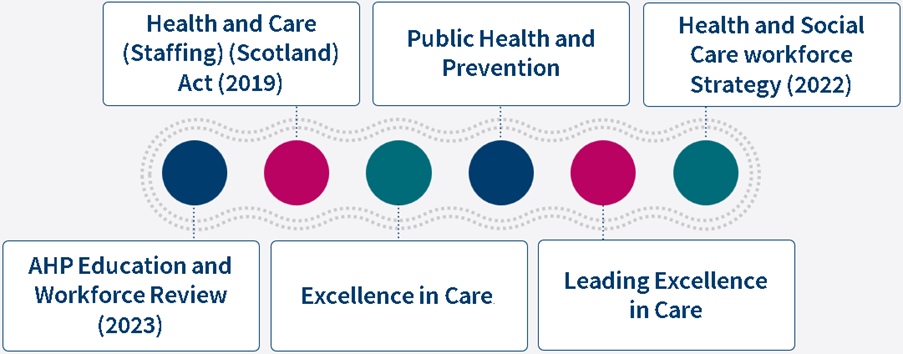
Specific to Job Planning, one of the many benefits is that it supports services to meet the requirements of policy and legislation and can support individuals to feel that the legislation is relevant to them and their service on a day-to-day basis. The details of how Job Planning can do this is outlined in this section.
The Allied Health Professions – Education and workforce policy review recommendations (2023)1 examined the steps required to implement a national education and workforce plan for AHPs, giving full consideration of all aspects of workforce measurement, planning and education needs for the future. Two recommendations made reference to Job Planning:
|
4.2 Workforce & Recruitment 2. National job planning for individual AHP groups should be undertaken learning from work in other professional groups. Additional support should be available to AHP leaders to enable this work to be undertaken. 5. Workload measurement tools for AHPs should be developed alongside National job plans that allow workload and workforce (demand) calculations to be made. Workload tools must be inclusive of the Four Pillars and encompass the entirety of AHP workload including public health, universal, targeted and individualised approaches. |
The Health and Care (Staffing) (Scotland) Act 20192 provides a statutory basis to ensure that health and care services have appropriate staffing in place, supporting safe, high‑quality care and better outcomes for service users. Due to the nature of AHP services, it can be difficult for us to use the tools currently available to identify capacity in a consistent way to report on what “appropriate” means. It can also be challenging to identify and report on service risks. Job Planning provides us with a tool that allows us to accurately reflect the capacity of our service to provide care for service users and the population as a whole.
The Health and Care (Staffing) (Scotland) Act (2019)2 also details that NHS boards have a duty to ensure adequate time given to clinical leaders. This time can be identified and allocated within individuals Job Plans.
Using Job Planning can also support the allocation of time to facilities arrangements and duties (Facilities Arrangements for Trade Unions and Professional Organisations Policy | NHS Scotland)3.
One value of job planning is in maximising the contribution of AHPs’, by effectively planning capacity which includes capacity for population health. The Scottish Government Workforce Strategy (2022)4 highlights the need for increased prevention and early intervention approaches to promote Scotland’s Health and Wellbeing outcomes and we know that AHP’s have a vital role in this5. Through Job Planning services are able to identify and allocated capacity per clinician and for the service for population health as part of Clinical Care.
The NHS workforce plays a pivotal role in implementing the Scottish Government Workforce Strategy (2022)4 vision of supporting a whole‑system approach to enhancing health and wellbeing outcomes for the people of Scotland. This vision includes a sustainable, skilled workforce with attractive career choices where all are respected and valued for the work they do. Through the implementation of Job Planning, time for continual professional development at all four Pillars of Practice is identified for each member of the team. This also leads to further provision of evidence-based practice by services, leading to improved outcomes for service users.
Job Planning can also have a positive impact on wellbeing as staff feel supported in their career development with appropriate workload aligned with their identified capacity. It also provides a framework for consistent support across a team or service. In the longer term, increased staff wellbeing can lead to improved service user outcomes.
References