

Previous
How - Skills maximisation (under development)

Skills Maximisation is a structured, collaborative method that helps teams understand their work, optimise roles, and redesign services to deliver safer, more efficient, and more sustainable care.
The core idea is to make the best use of everyone’s skills, so service users get the best possible care.
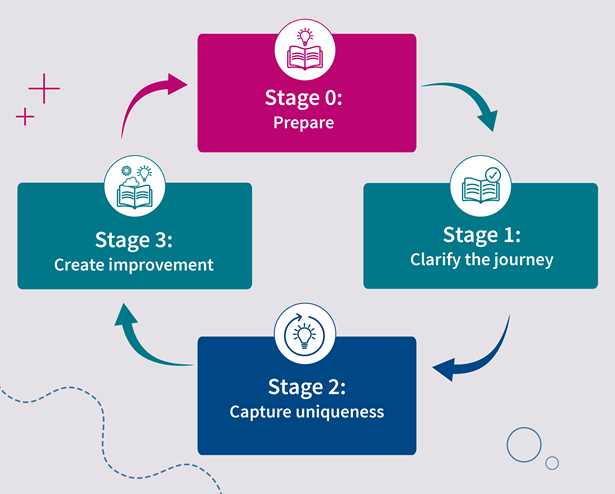
The 4 stages are:
 |
Stage 0 - Prepare This stage helps you explore, learn, and prepare your thinking. |
 |
Stage 1 - Clarify the journey This stage helps you and your team to understand the bigger picture, to identify and clarify your journey, and to gather differing perspectives. Process mapping can be used. |
 |
Stage 2 - Capture uniqueness This stage helps you and your team to focus on your contributions, and to gather and analyse the data you need. |
 |
Stage 3 - Create improvement This stage helps you and your team to create, plan and support change improvement cycles, and develop your business case. |
 |
What? |
Skills Maximisation is a structured, collaborative method that helps teams understand their work, optimise roles, and redesign services to deliver safer, more efficient, and more sustainable care. The core idea is to make the best use of everyone’s skills, so patients get the best possible care. The Skills Maximisation Toolkit supports teams to follow a 4-stage structured process to help understand and maximise the contributions and capabilities of AHPs to address issues, create improvements and design and deliver the best service they can. |
 |
Why? |
Skills Maximisation can help you and your team address:
|
 |
Who? | Intended users: teams of HCPC‑registered and non‑registered staff. It can also be used effectively within wider multidisciplinary teams and includes meaningful involvement of people who use the service and their families. |
 |
How? |
Getting started: The Skills Maximisation Toolkit guides teams through 4 stages:
|
 |
Resources | Take time to prepare and gain perspectives from the case studies to ensure skills maximisation is the approach you wish to use. Utilise the Skills Maximisation Toolkit method and facilitator and participant workbooks, freely available on this website. |
 |
Timeframes and capacity | Will be dependent on the scale and scope of the work. The case studies included demonstrate examples of team and service level change, and resources and engagement involved. |
Skills Maximisation can help you to:
|
The purpose of skills maximisation is:
|
The aim is to support service re-design and allow those involved to be clear about the skills and skill mix needed to provide good quality services. It strengthens skills in teamworking, service improvement, and recognising the unique value of each role.
|
To start—go to Introduction to Workforce planning and transformation page of this resource. |
This will help you to:
Skills Maximisation is one option within the wider workforce planning and transformation process. It helps services make the most of their existing workforce by aligning staff skills with service needs. There is no one size fits all approach and the rationale for choosing one approach over another may be based on a number of factors: including familiarity with approach, alignment of approach with challenges, desired outputs or outcomes of your work/service and strategic drivers- i.e. ‘best fit’.
|
You might choose this approach because it:
|
Skills Maximisation overview
Watch this video which gives an overview of Skills Maximisation (total time approx. 16mins). Introduction Skills maximisation power point presentation- edited.pptx. Download the video transcript (insert link)
Background to the Skills Maximisation toolkit
First published in 2007, the AHP Skills Maximisation Toolkit was developed to help AHP services enhance their contribution to patient/service user pathways. The original materials have now been reviewed and updated into easy-to-navigate, web-accessible resources.
How to start your Skills Maximisation learning journey
The Skills Maximisation toolkit guides you through the four stages. Use the links below to access supporting resources
 |
Stage 0 - Prepare |
 |
Stage 1 - Clarify the journey |
 |
Stage 2 - Capture uniqueness |
 |
Stage 3 - Create improvement |
Workbooks and templates – Information about the respective stages within the workbook are linked above. This is the best staring place to take you through each stage. The full workbook covering all stages can be found here: Skills Maximisation Workbook.docx. (This workbook still needs work/reviewing).
Glossary - If any terms are new to you, please refer to Glossary for Skills Max.docx (need to create one glossary page for whole site arranged in alphabetical order)
Skills Maximisation in action - Case studies
Click on the case studies link above to explore real examples of how AHP services have applied the Toolkit in practice to support your learning journey.