

Previous
Skills max toolkit - Stage 2: Capture uniqueness

 |
Stage 3: Create Improvement |
Aim: The aim is to identify your plan for test(s) of change.
This stage is all about logging the results of your research and identifying small tests of change to carry out based on the information you collated in 2.3 Identifying areas for Improvement.
|
Process
|
You can work through this process using Workshop 3: NES Workshop 3 - Steps 3.1 & 3.2.pptx
|
Questions
|
You may find the associated resources helpful in identifying and carrying out Tests of Change:
Links
TURAS QI Zone: Testing Changes
Tools and Resources
NES Workshop 3 - Steps 3.1 & 3.2.pptx
3.1.1 Prioritisation Tool Examples (same as 0.2).docx
There are several approaches that can assist with establishing priorities. Have a brief look through and identify which one may assist you with the purpose of prioritising your improvement needs.
 |
Priority Matrix |
 |
The Covey Matrix |
 |
Impact versus effort Matrix |
 |
Pareto Analysis |
 |
Stacey Matrix |
 |
Developing and Implementing Tests of Change |
The aim is to recognise the emotions involved in change
The next logical stage is to make the case for the change/improvement to be taken on board by the team and change the patient journey for the better. Sounds simple, however we all know that gaining resources to sustain an improvement and getting people to change their historic, comfortable ways of working is not always easy.
To support you in this area you have already given some thought as to who you need to influence and how you might overcome the challenges. It is important to reflect on this now.
|
This stage will provide information on:
|
Stage 3: Creating Improvement will be useful for thinking about responses that the change might bring from you or the team, and also to think about presenting the business case of the change as is required.
You may find the associated resources helpful in supporting change in your service:
Links
Turas QI Zone: Create the Conditions
Creating conditions | Turas | Learn
Turas QI Zone: Learning Programmes
Institute for Healthcare Improvement: The Psychology of Change Framework
Behaviour change for health | NHS Education for Scotland
Scottish Approach to Change – Healthcare Improvement Scotland
The Emotions of Change
The model below is a “Change Curve” adapted from the work of Elisabeth Kübler-Ross on bereavement. (Kübler-Ross Change Curve® )
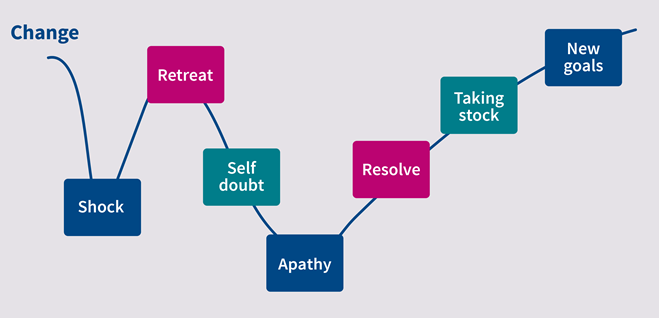
Management theorists recognised that the death of someone close was one of the biggest changes that we had to deal with in life and took her model on bereavement and adapted it as a tool to help individuals manage other changes.
|
The Change curve illustrates the stages we may go through when change occurs. These are:
|
The stages of the curve represent the stages that we may go through, or become stuck at, when change occurs whether that change is positive or negative. It is important to realise that the curve is not a continuum, there is no need to go through each stage in
order to progress to the next, indeed individuals may hit the curve at different stages. All of which makes the role of the AHP leading the change more challenging given the position they may have on the curve themselves.
|
Think about:
|
Like all the models and information that have been provided as part of the SMT process, this is not a tick sheet of certainties that will guarantee a result every time, we know people are different.
| Area of change curve |
Things you might see and hear |
Influencing change |
|
Shock
|
The verbal communication may be non-existent or aggressive and confrontational. The behaviours that accompany shock are firmly in the emotional zone and may be happening subconsciously. |
No matter what is happening for individuals here it may not be what it seems. Important not to get hooked into the behaviour. Use questioning to find out where the individual/s are really coming from and what you can do to support and help them. Lots of listening and not too much talking.
|
|
Retreat
|
Th word describes what may be happening for people, a withdrawal, verbally and even physically. Limited verbal communication, internalising of the situation and events.
|
Team members/individuals are no good to you if they are not making a contribution. You need to find ways to bring them back from the outside through empathy, encouragement and asking them what they feel concerned/afraid of and really listen to the answers.
|
|
Self-doubt
|
Change brings concern and fear. This naturally gets people to box themselves into a corner where they decide what is going to happen and that there may not be a place for them in the new regime. Many of the behaviours from retreat are still likely to be evident at this stage, however it is important to recognise that self-doubt sometimes presents as over confidence.
|
Paint the picture for individual of what the future will look like and the role that you see them playing in that future. Confirm successes and achievements. Provide small incremental milestones for individuals and the team and ne proactive with feedback to provide an impetus towards continuous improvement. Usually this will bring individuals around, this is about self-belief and worth not about wanting to be part of the change.
|
|
Area of change curve |
Things you might see and hear |
Influencing change |
|
Apathy
|
Apathetic people are around in the workplace anyway, with or without change. Recent studies reckon that we only get something like 28% capacity from individuals. You will know whether the apathy is unusual and due to the change or just part of the ‘character’ of the individual. This is typified by a ‘don’t car’ attitude, a lack of tea-work and generally a lack of personal responsibility. Can be self-centred.
|
We often spend lots of time and energy with individuals who are in apathy, this often creates time management pressures and resentment from the rest of the team who are trying to get on with things. Do not reward poor performance, attitude and behaviour by providing the individuals with your most precious commodity, your time. Make sure that you are clear that the person is in apathy and not self-doubt as the strategies for dealing with these are different. A wake-up call may be required here regarding the potential consequences of continued inappropriate behaviour – hopefully as a last resort!
|
|
Resolve
|
At this stage the behaviour is more positive than it has been up to this time. Even if the feeling is ‘we have no choice but to get on with it’ there is a definite feeling of movement here that doesn’t exist in the previous stages. This presents itself as physical and emotional change as people begin to get on, get going, go with the flow and make a start.
|
This is the time for you to capture the change in mood and set out the vision, influence each individual appropriately and energise the moving forward that has begun. Setting out the importance of everyone’s contribution, providing structure and guidance around requirements and communication. |
|
Taking stock
|
The next logical stage from resolve and likely to follow on. An analytical and problem-solving area likely to be accompanied by lots of discussion and questions, reflections and predictions. Engages left brain thinkers those who like detail and structure. |
Time to keep the team with you. Lots of listening to their ideas and perceptions, a different perspective now can often save a lot of time, energy and team hassle later on. Remember that everyone is entitled to contribute to the vision, otherwise how will they own it and begin to feel passionate about it. |
|
Area of change curve |
Things you might see and hear |
Influencing change |
|
New goals
|
The exciting beginnings of planning to deal with the change. Team members may not all necessarily be delighted, proactive and dynamic about the change and there will still be traces of ‘because we have to’ attitude. Enthusiasm may run away with itself, and initial excitement may soon wane.
|
Watch out for the ‘bench sitters’, the under-miners and the ‘we’ve done this before’ brigade. Give these people important roles and minor closely! Make the best use of the team, delegate within areas of competence, agree ground rules for communication, action planning and feedback. Crucial to keep energy up now and take the team with you. Watch out for setbacks, predict and positively influence areas where challenges appear. Make sure that you provide training and support for the team, time out to think and lots of praise for achievements, no blame for setbacks. Finally remember to look after yourself! |
|
Questions
|
Aim: To support your preparation of a business case
We are more aware than ever as AHPs about the importance of maximising the use of resources and yet the concept of business or anything to do with business still seems like an alien one to most of us. However, using business processes and ideas such as presenting a ‘Business Case’ can help us to get what we want in terms of securing resources or even just the authority to make the improvement that we believe will improve the service user journey.
Everyone in the system has something that they need to deliver on. The smart move is to build your business case around those desired deliverables whilst using the evidence gained from completing stages 1 and 2 to clearly describe the benefit to the service user.
Remember that a business case doesn’t need to be complex, but it does need to be well written, should appeal to the recipients and be clear in its message.
|
Some pointers that might be helpful:
|
You may find the associated resources helpful when writing a business case for your service:
Links
Engaging stakeholders
Planning your communication | Turas | Learn
Writing a business case
Each Health Board will have a business case template. The below questions are what you might wish to consider when developing a business case.
|
Questions
|
Check List:
| Stage 3: Creating Improvement |
| Stage | Questions to ask |
|
The emotions of change SMT Workbook p41 |
|
|
Making it real where you are SMT Workbook p45 |
|
|
The business of change SMT Workbook p46 SMT Workbook tips p47 |
|
|
Business case development SMT Workbook p46
|
|
|
Making it real where you are SMT Workbook p46
|
|
|
Writing the business case SMT Workbook p48
|
Information to include and suggested headings are given below:
|