

Skills max toolkit - Stage 1: Identify

03
Stage 1: Identify the journey

Aim:  Together with your team, you choose the patient/service user journey to focus on.

You may use some or all of the following to discuss and agree your journey to focus on: 

  • Data e.g. high demand data, high risk data, capacity data etc. 
  • Consultation with team members e.g. clinical and professional experience, feedback,  
  • Feedback from service users, and from the wider multi-disciplinary team 

More prompts are available Link to: 0.1 Prepare to identify your journey.docx


This could be done through: 

  • Data
  • Consultation with team members
  • Feedback from service users

 This should then be shared with the team. 


Questions 

  • What are key questions you want to answer about your service? 
  • Are there services in your health board where your professional expertise could be making a difference? 
  • Where do you believe you can make a positive impact on service users? 
  • Which specific service user journey are you looking at improving? 
  • Where are there blockages or delays? Where is there high demand? What are the main issues? 
  • What is the data telling you?  
  • Why have you chosen this journey? 
  • Who needs to be involved? 
  • Managers/practitioners/support staff/individuals using the service/people from similar services – involve as many contributors to the patient journey as possible

1.2 Clarify the journey

What constitutes a process? 

All the work that is done in an organisation can be described in terms of processes. A service user journey can be thought of as a process. The terms used were developed within industry but have been applied to a health service setting. Often this requires a major change in thinking because in the past we may have thought only in terms of departments and functions. A process is a collection of cause factors that interact to produce a given output. In our case these cause factors are the elements which are applicable in terms of their impact on the process (service user journey) and the output (quality of services provided to the service user). 

Service users’ needs are always changing. The process should continually change to meet changing needs, through process improvement. 
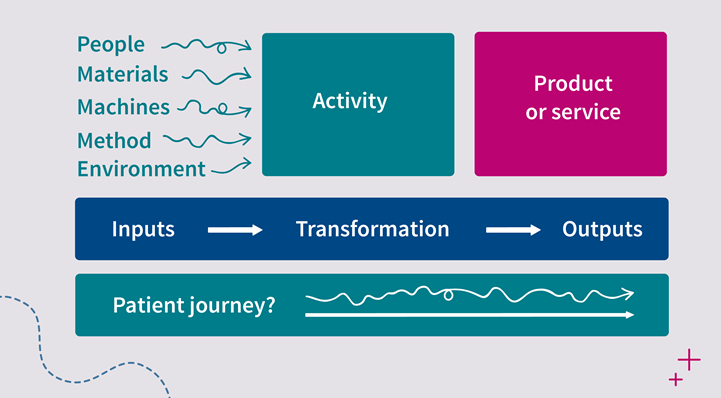
Cause factors are often called inputs, and include the following: 

  • People
  • Materials
  • Machines
  • Method
  • Environment

Activity and Transformation 

Activity is what transforms the input into the final product or service, and may be: 

  • Diarising an appointment using a computer system or traditional diary
  • Discussions between multi-disciplinary team members
  • Creating an x-ray
  • Passing information from one person or department to another.

Product / Service and Outputs 

Products and services are what come out of the process and could include: 

  • Treatment or therapy
  • Another appointment
  • An operation
  • An assessment
  • A support package.

You may find the associated process mapping resources helpful: 

Turas Learn: Quality Improvement Zone: QI Tools: Process Mapping 

Things to remember: 

  • The process/service/journey you are looking at needs to be clearly defined and understood by all involved.  
  • You need to identify the range of people who need to be involved for you to effectively look at the journey 
  • People need to feel they are free to express their views openly and honestly 
  • Document the discussion as you go along and recap occasionally 
  • There will be a range of different views amongst the group, and consensus from the start is unlikely 
  • You are trying to map what really happens – not what should happen! 
  • Draft out a basic flow chart of the patient journey from the information gathered 


Collated Questions

  • What is the purpose of the service?  
  • The purpose/aims/reasons for the service existing need to be clearly stated and understood by all involved 
  • What is the ‘output’ of this service, or what does it do? 
  • Therapy/another appointment/an operation/an assessment/a support package 
  • Who is involved in providing the service and what are their capabilities? 
  • Practitioners support staff; KSF job outlines/their accounts of what they do/training 
  • Which other disciplines need to be involved in looking at the patient journey? 
  • What information do you need and where can it come from? 
  • What information exists or can be collected to help understand the current process? 
  • Referral rates/waiting times/workforce information/treatment rates/treatments provided/other work going on in your professions or Health Board area 
  • Where can you get this information from? 
  • Colleagues/managers/HR/Health Board reports/ISD 
  • What other information do you need to collect yourselves? Who can help? 
  • Who is accountable for the overall journey/process? 
  • How does the process/service operate? 
  • What is it supposed to do? How does this happen? What is it capable of doing? 

You may find the information here useful: 

Link to Skills Maximisation Workshop 1 : Facilitator slides 

NES Workshop 1 -Steps 1.2, 1.3 & 1.4.pptx 


1.3 Agree the patient journey

Your team work together to agree a Process Map of the service users, the person and their families/carers current journey. 

Consider: How do you wish to visualise your process map?

Resource: A table template is offered in Activity Analysis in stage 2 of AHP Skills Maximisation; Link to: 2.2.1 Activity Analysis - template.docx

Facilitator Presentation: Link NES Workshop 1 -Steps 1.2, 1.3 & 1.4.pptx

Options:

  1. Face to face: Form small groups, use post it notes to write down each step of the journey.
  2. Use breakout rooms to discuss each step of the journey – create a list in a shared Word document / SharePoint or use other Microsoft apps such as Loop Notes.

Check List:

Stage 1: Clarifying the Patient Journey

Stage

Questions to ask

Mapping the journey

SMT Workbook p9

  • Who is involved, what is needed for the work to happen?
  • What activities are carried out?
  • What is the result?
  • Reflect on the journey

Clarifying the patient journey – making it real where you are

SMT Workbook p12

SMT Workbook experiences p12

  • What journey are you looking at improving?
  • Why have you chosen this journey?
  • Who needs to be involved?

Understand the service

SMT Workbook p13

  • What is the service you are providing?
  • What is the ‘output’ of this service?
  • Who contributes to providing the service and what are their capabilities?
  • What information exists or can be collected to help understand the current process?

Who is responsible for providing the service?

SMT Workbook p14

  • How does the service operate?
  • Who are the patients and what are their requirements?

Mapping the journey

SMT Workbook p15

SMT Workbook experiences p16


  • Map what really happens

Getting feedback from the patient

SMT Workbook p17

SMT Workbook experiences p18

  • How will you ensure that the patient perspective of the journey is included in your map?
  • After collecting the patient’s perspective, record your findings and modify or add comments to your map
  • Who are the stakeholders in the process and how might you get information to them?

Example In Action

Delegates attended a series of NHS Education for Scotland consensus events. They analysed the processes involved in completing a routine chest x-ray. Delegates worked in small groups to identify steps, then these steps were combined to agree the process map.
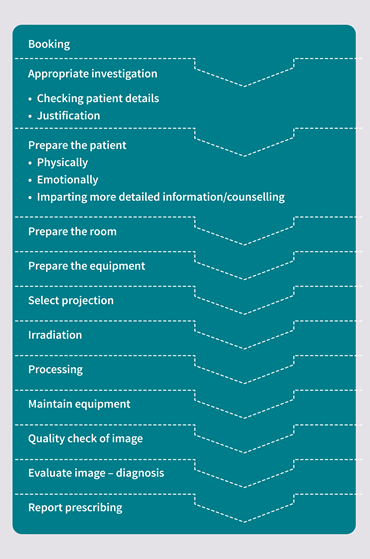
SMT In Action - Case studies in full.pptx


1.4 Feedback from individual carers

The aim of this section is to guide you to consider different perspectives

Naturally the most important person in the process is the individual so it is critical to gain feedback from their perspective of the journey. You may be able to do this via existing feedback groups or from current data that is readily available. If not, you may want to invite feedback from individuals and carers that have recently been involved with your service.


You may find the associated resources helpful when engaging individuals and carers in the SMT process:

HIS: Engaging Communities
Engaging communities – Healthcare Improvement Scotland

Turas: Person Centred Care
Person-centred care zone | Turas | Learn

Health and social care - Planning with People: community engagement and participation guidance - updated 2024
Annex A – Supporting information resources - Health and social care - Planning with People: community engagement and participation guidance - updated 2024 - gov.scot